Self-Employed Tax Prep Checklist for Freelancers

A self-employed tax prep checklist is a structured document that organizes every income record, expense receipt, and deduction category you need to file your taxes accurately. The IRS requires self-employed individuals to report income and expenses on Schedule C and pay self-employment tax using Schedule SE. Filing without a checklist means risking missed deductions, misclassified expenses, and potential audit exposure. Starting your preparation early, ideally in january or february, gives you time to reconcile records and resolve gaps before the april deadline.

What income documents do self-employed individuals need?
Every freelancer's tax preparation guide starts with income documentation. The IRS cross-references what you report against what payers report, so gaps trigger notices. Collect every income source before you open your tax software.
The core income documents to gather include:
- 1099-NEC forms from any client who paid you $600 or more during the year
- 1099-K forms from payment platforms like PayPal, Stripe, or Venmo if you crossed their reporting threshold
- Direct deposits and wire transfers from clients who did not issue a 1099
- Cash payments recorded in your own invoicing or accounting system
- Prior year tax return to verify carryover figures and confirm your prior adjusted gross income
Reconciling your own records against every 1099 you receive is non-negotiable. If a client reports $8,500 on a 1099-NEC but your invoices show $9,200, the discrepancy needs an explanation before you file. The IRS matches reported figures automatically, and underreporting triggers automatic notices.
Pro Tip: Request a transcript of your IRS account at IRS.gov each february. It shows every 1099 filed under your Social Security number, so you can spot missing or incorrect forms before your return is due.
Your self-employed income checklist should also include any barter income, rental income tied to your business, and interest earned in business accounts. These amounts are taxable even without a formal 1099. Accurate recordkeeping requirements per IRS Publication 334 cover all income types, not just those reported on information returns.
How to organize and document business expenses for maximum deductions
IRS Publication 334 defines a deductible business expense as one that is both ordinary (common in your industry) and necessary (helpful and appropriate for your work). That two-part test applies to every line on your Schedule C. Documentation is what makes a deduction defensible.
Common deductible expenses for sole proprietors
- Software subscriptions used exclusively for business
- Professional development, courses, and industry publications
- Home office expenses (dedicated workspace only)
- Business phone and internet, prorated for business use
- Health insurance premiums (deductible above the line for self-employed individuals)
- Retirement plan contributions to a SEP-IRA or Solo 401(k)
- Bank fees on business accounts
- Marketing, advertising, and website costs
The home office deduction requires precise measurements of your dedicated workspace and documentation of utilities, rent or mortgage interest, and repairs. Estimates do not hold up under audit. Measure the square footage of your office and divide it by your home's total square footage to calculate the allowable percentage.
Vehicle expenses follow a similar standard. The IRS mileage rate for 2025 is $0.70 per mile, and every log entry must include the date, destination, business purpose, and total miles driven. A mileage log reconstructed from memory at tax time is not defensible. Use a mileage tracking app or a dedicated notebook throughout the year.
Meals present a specific documentation trap. The IRS allows a 50% meals deduction only when you record the business purpose and the names of attendees on or with the receipt. A credit card statement alone does not satisfy this requirement.
Pro Tip: Open a dedicated business checking account and a business credit card on day one of your freelance work. Every transaction flows through those accounts, and your monthly statements become a near-complete expense record with no sorting required.
Separating personal and business finances is the single most effective method to simplify tax prep and avoid missing deductions. Commingled accounts force you to review every transaction individually, which multiplies both time and error risk.
What tools and practices simplify self-employed tax preparation?
The right tools reduce manual data entry and improve data integrity across your entire filing. No single tool does everything, so freelancers typically combine two or three categories.
| Tool category | Primary function | Key feature to look for |
|---|---|---|
| Bookkeeping apps | Track income and expenses in real time | Automatic bank feed import and category rules |
| Mileage trackers | Log business drives automatically | GPS-based trip detection and IRS-compliant reports |
| Receipt management | Capture and store expense documentation | OCR scanning and cloud storage with search |
| Statement converters | Convert PDF bank statements to structured data | IRS Schedule C category mapping and batch processing |
| Tax filing software | Prepare and submit Schedule C and SE | Self-employment income support and estimated tax tools |
Tax software selection depends directly on income complexity. Simpler filers under $50,000 can use lower-cost tools effectively, while higher-income freelancers benefit from platforms that include CPA review. Choosing software above your complexity level wastes money. Choosing below it risks errors on deductions you are entitled to claim.
Quarterly estimated tax payments require their own tracking system. Self-employment tax runs approximately 15.3% of net earnings, and the IRS expects payments in april, june, september, and january. Missing a quarterly payment triggers underpayment penalties even if you pay in full by the april filing deadline. Keep a running record of each payment date and amount with your Form 1040-ES vouchers.
A guided, repeatable tax prep process that imports financial data and maps transactions to IRS categories reduces manual errors significantly. Taxbatchpro does exactly this: it converts scanned bank and credit card statement PDFs into structured, IRS Schedule C-mapped Excel spreadsheets in under 90 seconds. That eliminates the manual transcription bottleneck that causes most categorization errors.
Pro Tip: Run your bank statements through a PDF-to-Excel converter before your first categorization session. Starting with structured data instead of raw PDFs cuts your prep time in half and reduces the risk of missing transactions buried in multi-page statements.
Common self-employed tax mistakes and how to avoid them
Most audit triggers and missed deductions trace back to a small set of recurring errors. Knowing them in advance is the most cost-effective form of tax planning.
- Mixing personal and business finances is the most common mistake freelancers make. Separate accounts from the start to prevent this entirely.
- Undocumented meals claimed without business purpose notes or attendee names will be disallowed in full.
- Reconstructed mileage logs created after the fact lack the contemporaneous detail the IRS requires.
- Missing receipts for expenses over $75 leave deductions undefended. Store digital copies immediately after purchase.
- Timing errors on income recognition, such as reporting a december invoice in the wrong tax year, create discrepancies that trigger notices.
- Skipped retirement contributions are one of the most overlooked deductions. A SEP-IRA contribution can be made up until the filing deadline, including extensions.
The most overlooked deductions consistently involve meals without proper business purpose documentation, vehicle mileage without detailed logs, and retirement plan contributions that freelancers simply forget to make before the deadline. Addressing all three before you file can materially reduce your tax liability.
Maintaining organized and defensible records throughout the year is far less work than reconstructing them under audit pressure. A tax-ready bookkeeping practice means your records are audit-ready on any given day, not just in april.
Step-by-step approach to filing with your tax prep checklist
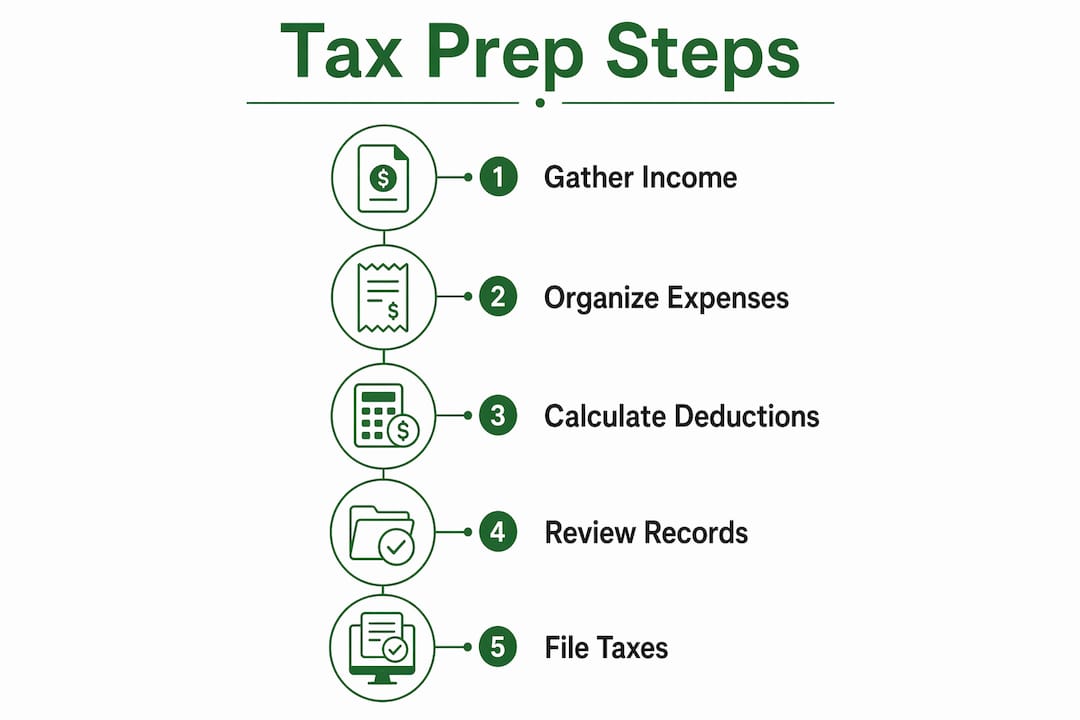
Gathering all documents before any categorization or calculation reduces burnout and misclassification errors. This sequence works for first-time filers and experienced freelancers alike.
- Collect all income documents. Pull every 1099-NEC, 1099-K, and bank statement showing client payments. Do not start categorizing until this step is complete.
- Gather all expense records. Compile receipts, credit card statements, invoices, and mileage logs. Include home office measurements and utility bills if applicable.
- Reconcile income against 1099s. Compare your own records to every information return filed under your Social Security number.
- Categorize expenses by Schedule C line. Map each expense to the correct IRS category: advertising, utilities, office expenses, travel, meals, and so on.
- Review deductions for documentation completeness. Every home office, vehicle, and meals deduction needs supporting documentation before you proceed.
- Confirm estimated tax payments. Pull Form 1040-ES records and verify each quarterly payment date and amount.
- Cross-check with your prior year return. Verify that carryover figures, depreciation schedules, and prior-year losses are correctly reflected.
- Review the complete return before filing. Check that Schedule C net profit flows correctly to Schedule SE and then to Form 1040 Line 8.
Organizing documents before categorizing is the single most effective way to reduce errors and filing fatigue. The table below summarizes the key checklist items for quick reference.
| Checklist item | Document or action required |
|---|---|
| Business income | 1099-NEC, 1099-K, bank statements, invoices |
| Business expenses | Receipts, credit card statements, vendor invoices |
| Home office | Square footage measurements, utility and rent records |
| Vehicle use | Mileage log with dates, destinations, and business purpose |
| Estimated tax payments | Form 1040-ES records with payment dates and amounts |
| Prior year return | Full copy for reference on carryovers and AGI |
Key Takeaways
A complete self-employed tax prep checklist covering income, expenses, deductions, and documentation is the most reliable way to file accurately, maximize deductions, and stay audit-ready.
| Point | Details |
|---|---|
| Gather income first | Collect all 1099-NEC, 1099-K, and direct payment records before categorizing anything. |
| Document every deduction | Meals, mileage, and home office deductions each require specific supporting records to be defensible. |
| Separate finances | A dedicated business account and credit card eliminate the most common source of missed deductions. |
| Track estimated payments | Record every quarterly payment date and amount to avoid underpayment penalties at filing. |
| Use structured data tools | Converting PDF statements to structured Excel data before categorizing reduces errors and saves time. |
Why I think most freelancers file with one hand tied behind their back
After years of watching self-employed individuals approach tax season, the pattern is consistent: most people treat tax prep as a once-a-year event instead of a year-round practice. That single habit creates every downstream problem, from missing receipts to reconstructed mileage logs to the annual panic of reconciling twelve months of commingled transactions in two weeks.
The freelancers who file with confidence share one trait: they maintain a living record. They reconcile monthly, not annually. They store receipts digitally the day they occur. They log mileage in real time. By the time april arrives, their "tax prep" is mostly a review, not a reconstruction.
Technology has made this easier than it has ever been. Automated statement extraction, AI-driven category mapping, and cloud-based receipt storage have removed the manual transcription work that used to make monthly reconciliation feel like a second job. The tools exist. The gap is adoption.
My honest advice: treat your first week of january as your tax prep kickoff, not your last week of march. Pull your statements, run them through a converter like Taxbatchpro, and do a rough reconciliation before you have forgotten what half the transactions were for. That one habit will save you more money and stress than any single deduction you could find.
— Ian
How Taxbatchpro fits into your tax prep workflow
Taxbatchpro converts scanned bank and credit card statement PDFs into structured, tax-ready Excel spreadsheets, with transactions automatically mapped to IRS Schedule C categories. A full year of statements processes in under 90 seconds, eliminating the manual transcription that causes most categorization errors.
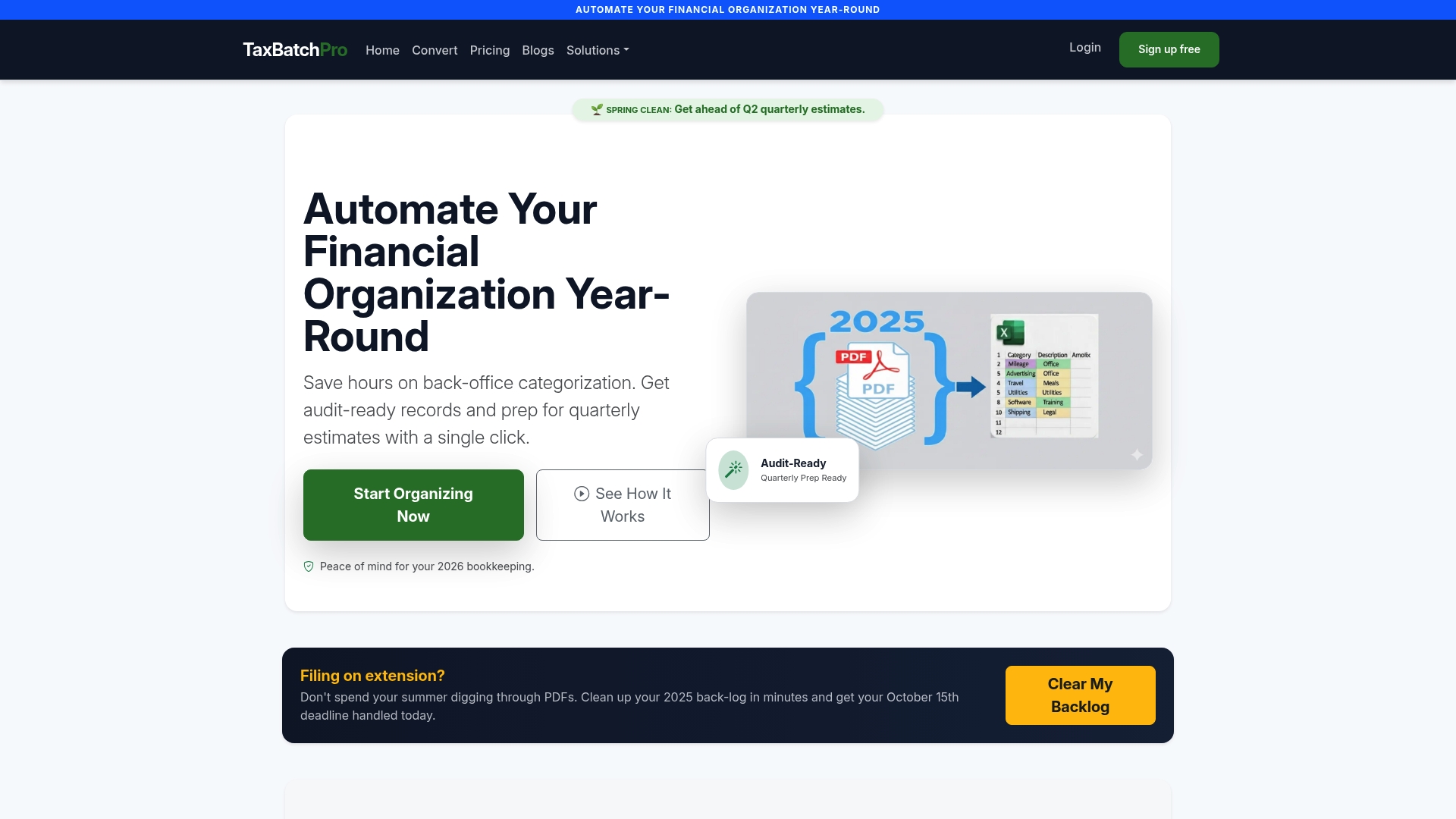
For freelancers preparing Schedule C and Form 1040, that means starting every categorization session with clean, structured data instead of raw PDFs. The platform supports IRS-ready statement conversion for self-employed filers and offers a dedicated workflow for accounting professionals managing multiple clients. Audit-ready formatting is built in, so your records are defensible from the moment you export them.
FAQ
What is a self-employed tax prep checklist?
A self-employed tax prep checklist is a structured list of every income document, expense record, and deduction category needed to file Schedule C and Schedule SE accurately. It reduces errors and helps freelancers capture every deduction they are entitled to claim.
What income documents do freelancers need to file taxes?
Freelancers need all 1099-NEC and 1099-K forms received, bank statements showing direct client payments, and their prior year tax return. Any income without a 1099 must still be reported based on personal records.
How do I document a home office deduction?
The home office deduction requires the exact square footage of your dedicated workspace, your home's total square footage, and records of rent or mortgage interest, utilities, and repairs. Estimates are not sufficient for IRS purposes.
When are quarterly estimated tax payments due?
Estimated tax payments are due in april, june, september, and january for the prior quarter. Missing a payment triggers an underpayment penalty even if you pay the full balance by the april filing deadline.
What is the IRS mileage rate for 2025?
The IRS business mileage rate for 2025 is $0.70 per mile. Each log entry must include the date, destination, business purpose, and total miles driven to be accepted as a valid deduction.