What Is a Client-Ready Financial Report?

A client-ready financial report is a polished, branded document that transforms raw accounting data into clear, actionable insights a business owner can actually use. Unlike a raw ledger export or an unformatted spreadsheet, this type of report follows recognized standards such as GAAP or IFRS, includes a narrative executive summary, and presents financial statements in a logical sequence. For small business owners and freelancers, understanding this format is the first step toward better bookkeeping conversations and stronger advisory relationships. Timely delivery matters too: delivering reports by the 10th of the following month keeps the insights relevant and the advisory conversation current.
What is a client-ready financial report, and why does it differ from raw data?
A client-ready financial report is the industry's term for what accountants also call a "management report" or "client deliverable." The phrase signals that the document has been prepared, formatted, and reviewed specifically for a client audience, not for internal bookkeeping use. Raw bookkeeping data, such as a transaction export or a trial balance, contains the same numbers but lacks the structure, narrative, and visual context a business owner needs to make decisions.

The difference shows up immediately in how the two documents read. A raw export lists every transaction in chronological order with no explanation. A client-ready report groups those transactions into standardized statements, adds a written summary of what the numbers mean, and flags anything that needs the client's attention. That shift from data to interpretation is exactly what clients pay for, and it is what separates a bookkeeper from a trusted financial advisor.
GAAP (Generally Accepted Accounting Principles) and IFRS (International Financial Reporting Standards) provide the framework that makes these reports comparable and credible. Following either standard means your client can hand the report to a lender, investor, or tax preparer with confidence. Avoiding jargon and formatting narratives for broad audiences ensures the report works for business owners without accounting backgrounds.
What financial statements make up a client-ready report?
A complete client-ready report contains four core financial statements, prepared in a specific sequence. Each statement feeds into the next, so the order is not arbitrary. Skipping a statement or presenting them out of sequence creates reconciliation gaps that undermine the report's credibility.
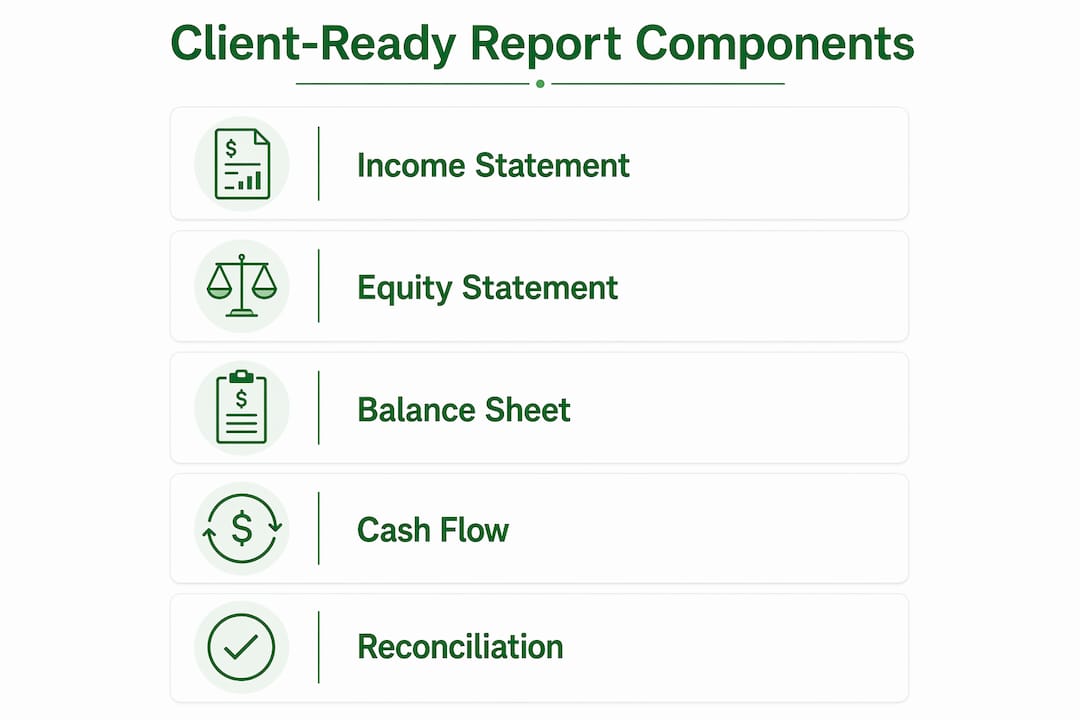
The four statements, in preparation order, are:
- Income Statement — Shows revenues, expenses, and net income for the reporting period. This is always prepared first because net income flows directly into the next statement.
- Statement of Changes in Equity — Tracks how ownership interest changed during the period, incorporating net income from the Income Statement.
- Balance Sheet — Presents assets, liabilities, and equity at a single point in time. The equity figure must match the closing balance from the Statement of Changes in Equity.
- Cash Flow Statement — Breaks cash movement into operating, investing, and financing activities. The ending cash balance must reconcile with the cash line on the Balance Sheet.
This sequence is not optional. Net income must match between the Income Statement and the equity statement, and the cash flow ending balance must reconcile with the Balance Sheet. Any mismatch signals a data integrity error that must be resolved before the report reaches a client.
The table below summarizes each statement's primary purpose and its key reconciliation checkpoint.
| Statement | Primary purpose | Reconciliation checkpoint |
|---|---|---|
| Income Statement | Reports profit or loss for the period | Net income ties to equity statement |
| Statement of Changes in Equity | Tracks ownership changes | Closing equity ties to Balance Sheet |
| Balance Sheet | Snapshot of financial position | Cash ties to Cash Flow Statement |
| Cash Flow Statement | Explains cash movement | Ending cash ties to Balance Sheet |
GAAP and IFRS both require this reconciliation discipline. Following it protects data integrity and gives your client a report they can rely on.
How do you transform raw bookkeeping data into a polished report?
The transformation from raw data to a client-ready deliverable follows five defined sections that are now considered industry standard: Executive Summary, Profit and Loss Statement, Balance Sheet, Cash Flow Statement, and Trends and Observations. Each section serves a distinct purpose, and together they tell a complete financial story.
The Executive Summary is the most important section for client communication. It answers two questions in plain language: "How did we do?" and "What should we focus on next?" Keep it to one page. A client who reads only the Executive Summary should still walk away with a clear picture of the business's financial health.
The Trends and Observations section is where your expertise becomes visible. This is where you note a spike in operating expenses, a seasonal revenue pattern, or a cash flow gap that warrants attention. Clients pay for interpretation, not raw data, and this section is where that interpretation lives.
Formatting choices matter as much as content. A well-formatted report includes:
- Your client's branding — logo, color palette, and business name on the cover page.
- Prior-period comparisons — current month versus the same month last year, or current quarter versus the prior quarter.
- "Needs confirmation" flags — explicit labels on any line item where data is missing or unverified.
- Visual elements — bar charts for revenue trends, pie charts for expense breakdowns, and simple tables for key ratios.
- Non-editable PDF format — the final deliverable should be locked to prevent accidental changes.
Pro Tip: Write management commentary at a sixth-grade reading level. If your client's accountant is the only person who can understand the narrative, the report has failed its primary purpose.
Avoiding technical jargon is not about dumbing down the content. It is about respecting your client's time and making the report genuinely useful. A freelancer reviewing their quarterly financials does not need to know what "amortization of deferred financing costs" means. They need to know whether their cash position is healthy and what to watch next quarter.
Why does timely delivery matter in client financial reporting?
Delivery timing directly affects the report's usefulness. A report delivered six weeks after the period closes describes a business that no longer exists in its current form. Decisions made on stale data carry real risk, particularly for small businesses where cash positions can shift quickly.
The target is delivery by the 10th of the following month. That window gives the bookkeeper time to reconcile accounts and prepare the narrative while keeping the insights fresh enough to drive decisions. Automation reduces preparation time by 60–75%, which makes that 10-day window achievable even for firms managing multiple clients.
The business case for speed is clear. Clients who engage with their reports within 48 hours show a 31% higher conversion to advisory services. That single statistic reframes the report from a compliance deliverable into a revenue driver for accounting practices.
Pairing the report with a brief advisory meeting amplifies its value further. The report answers "what happened." The meeting answers "what do we do about it." Together, they create the kind of advisory relationship that retains clients and justifies premium fees. Accounting firms saving 6+ hours per client per month on manual report assembly can redirect that time directly into these higher-value conversations.
What are best practices for client-ready financial reports?
The most common mistake in client reporting is volume without context. Sending a client 40 pages of transaction detail with no narrative is not thorough. It is a burden. The report's job is to reduce cognitive load, not increase it.
Follow these practices to produce reports that build trust and drive decisions:
- Lead with the Executive Summary. It should function as a standalone document. If a client reads nothing else, they should still understand the period's key results.
- Flag uncertain data explicitly. Label any unconfirmed line item as "needs confirmation" rather than estimating silently. Assuming missing data undermines report integrity and erodes client trust when errors surface later.
- Use static PDFs for final deliverables. Static formats prevent editing and signal that the report represents a finalized, reviewed snapshot of the business's finances.
- Reserve live dashboards for collaborative work. Dashboards are useful during the review process, but they are not appropriate as final client deliverables because they can change after delivery.
- Customize for each client. A retail business and a freelance consultant have different key metrics. The report should reflect what matters to that specific business, not a generic template.
Pro Tip: Build a review checklist that runs before every report goes out. Confirm reconciliations, verify "needs confirmation" flags are resolved or labeled, and check that all prior-period comparisons are accurate. A five-minute review prevents a credibility-damaging correction email.
Consistent formatting across every report you produce also matters. When clients receive a report that looks and reads the same way each month, they build familiarity with the structure. That familiarity makes them faster readers and more engaged clients. Explore AI in accounting workflows to see how automation enforces formatting consistency at scale.
Key Takeaways
A client-ready financial report is defined by its structure, narrative, and delivery timing, not just the accuracy of its numbers.
| Point | Details |
|---|---|
| Definition and purpose | A client-ready report transforms raw bookkeeping data into a branded, narrative-driven document following GAAP or IFRS standards. |
| Four-statement sequence | Prepare statements in order: Income Statement, Equity Statement, Balance Sheet, Cash Flow, with reconciliation at each step. |
| Five report sections | Every report needs an Executive Summary, P&L, Balance Sheet, Cash Flow Statement, and Trends and Observations section. |
| Delivery timing | Deliver by the 10th of the following month; automation cuts preparation time by 60–75% to make this achievable. |
| Format and integrity | Use static PDFs for final deliverables and flag all unconfirmed data explicitly to protect report credibility. |
Why I think most small business owners never see a truly useful financial report
Most small business owners receive one of two things: a raw spreadsheet their bookkeeper exported, or a dense PDF that reads like it was written for a CPA exam. Neither one actually helps them run their business.
The real value of a client-ready report is not in the data. It is in the translation. When a freelancer sees that their net income dropped 18% quarter over quarter, they need to know why. Was it a slow client pipeline? A spike in software subscriptions? A one-time equipment purchase that won't repeat? The numbers alone do not answer that. The narrative does.
What I have seen consistently is that the accountants who invest in report quality, meaning clear language, logical structure, and timely delivery, retain clients longer and charge more. The report becomes the proof of value. It shows the client that someone is watching their numbers and thinking about their business, not just reconciling transactions.
The shift toward automation makes this more accessible than it has ever been. Tools that handle document data extraction remove the bottleneck of manual data entry, freeing up the hours that used to go into assembly and redirecting them into interpretation. That is the work clients actually value.
Small business owners should expect more from their financial reports. And accountants who deliver more will build the kind of practices that grow on referrals.
— Ian
How Taxbatchpro supports client-ready report preparation
Producing a polished financial report starts with clean, structured data, and that is exactly where most bookkeepers lose time.
Taxbatchpro converts scanned bank and credit card statement PDFs into structured, categorized Excel spreadsheets in under 90 seconds. Transactions are automatically mapped to IRS Schedule C categories, eliminating manual transcription and reducing the data preparation bottleneck that delays report delivery. For accountants managing multiple clients, the batch processing tools handle an entire year of statements at once, so the data foundation for every client report is ready when you need it. That speed translates directly into faster delivery, cleaner reports, and more time for the advisory conversations that grow your practice.
FAQ
What is a client-ready financial report?
A client-ready financial report is a branded, narrative-driven document that presents a business's financial statements, including the Income Statement, Balance Sheet, and Cash Flow Statement, in a format designed for non-accountant readers. It follows GAAP or IFRS standards and includes an executive summary with plain-language commentary.
What financial statements does a client-ready report include?
A complete report includes four statements in sequence: the Income Statement, Statement of Changes in Equity, Balance Sheet, and Cash Flow Statement. Each statement reconciles with the next to verify data integrity.
How often should client-ready financial reports be delivered?
Reports should be delivered by the 10th of the month following the reporting period. Delivery within that window keeps insights relevant and supports timely advisory conversations with clients.
What makes a financial report "client-ready" versus a standard export?
A standard export presents raw transaction data without context. A client-ready report adds a narrative executive summary, prior-period comparisons, visual elements, and explicit flags for unconfirmed data, all formatted as a non-editable PDF.
How does automation improve client financial reporting?
Automation reduces report preparation time by 60–75%, enabling faster delivery and freeing accountants to focus on interpretation and advisory work rather than manual data assembly.